Welcome to the Columbia College Student Learning Outcomes site. This site provides information to assist Columbia College faculty in understanding, developing, and implementing Student Learning Outcomes. Columbia College has chosen to implement Student Learning Outcomes throughout the college at the course, program, and institutional levels.
Columbia College uses SLO data, in addition to other metrics, to reflect on the college's performance as a whole. This reflection is more robust and meaningful when we have more complete data. This data is not used to consider the performance of individual instructors.
Student Learning Outcomes (SLOs) are statements that describe specific knowledge, skills, or abilities that students are expected to attain and can demonstrate upon the completion of a course or a program. For instruction, there are three types of student learning outcomes:
Course Student Learning Outcomes (CSLOs) are statements about specific knowledge, skills, and abilities student should be able to attain and demonstrate after the completion of a course.
The number of CSLOs a course has is determined by the minimum number of units required for the course:
As you write CSLOs consider Bloom's Taxonomy. Additionally, you can follow this template which aligns with Institutional Student Learning Outcomes (ISLOs):
'Upon satisfactory completion of the course students will be prepared to:'
Program Student Learning Outcomes (PSLOs) are statements about award specific knowledge, skills, and abilities that students should be able to attain and demonstrate after the completion of an award. PSLOs are not assessed directly but are based on the aggregation of CSLO assessments of courses in the program on the CSLO-PSLO mapping.
Most programs (academic awards) have two to five PSLOs.
Institutional Student Learning Outcomes (ISLOs) are broad statements of the general knowledge, skills, and abilities that all students should be able to attain and demonstrate. ISLOs are not assessed directly but are based on aggregations of CSLO assessments based on the CSLO-ISLO mapping.
There are six ISLOs at Columbia College (Commonly referred to as the ‘6 Cs’): Career, Communication, Critical Thinking, Knowledge, Culture and Community, and Calculation. Each ISLO begins with “Upon satisfactory completion of their course of study at Columbia College, students will be prepared to…
Columbia College’s ISLOs align closely to ACCJC Standard 2.3 regarding our general education framework.
Mapping is a required part in the evaluation of PSLOs and ISLOs. Each course CSLO is mapped to one of the six ISLOs and if the course a part of a program it is mapped to the one of the PSLOs.
In the chart below we can think of the red as representing the college and the six ISLOs and the yellow as a course with four CSLOs. Those CSLOs must be mapped to one (and only one) ISLO. The same structure follows with programs and PSLOs.
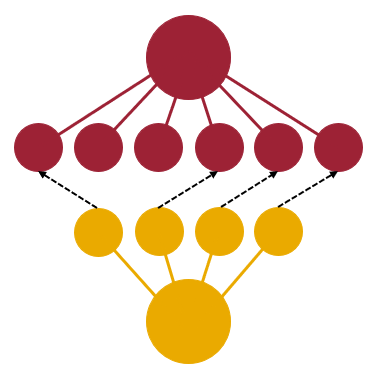
Since assessment is only done at the CSLO level, PSLOs and ISLOs are essentially aggregations of CSLO assessments. There are some important points about mapping in the interpretation of data:
It is the responsibility of the faculty member that is brings a program through curriculum to map a course’s CSLOs to the program PSLOs. If a course changes their CSLOs after a program has gone through curriculum, the Administrative Secretary of the Instruction Office will reach out to the faculty member to map the new CSLO.
This is an important part to consider before teaching a class. Assessments of CSLOs are entirely under the purview of each faculty member teaching a course. Some specific assignments, parts of tests, participation in class, projects, and presentations can all be used to assess student learning outcomes.
Yes.
Within each course, each student is assessed on the CSLOs using a 3-level assessment: Meets Expectations, Does not meet expectations, and Not Applicable (N/A). Here are some things to consider:
Student made sufficient progress on the material and passed most of the formative assignments AND passed summative assessment assignment.
OR
Student received a grade of A or B on assessments related to the CSLO.
Student made some progress on the material, but not at a passing level on multiple formative assignments OR did not pass summative assessment assignment.
OR
Student received a grade of D or lower on assessments related to the CSLO.
Student is auditing the class.
OR
Student withdrew from the class prior to this information being covered in the class.
OR
Student did not do the assignment related to the CSLO.
Insights is the Canvas integrated software that Columbia College has adopted to assess Student Learning Outcomes (SLOs).
All full-time and part-time faculty will be asked to use Insights to assess their SLOs in each course they teach beginning in fall 2026. Note that faculty teaching in Rising Scholars do not have access to Insights in the California Department of Corrections and Rehabilitation (CDCR) instance of Canvas. Please stay tuned for direction from the Vice President of Instruction about how to assess SLOs if you teach in Rising Scholars.
At the most basic level we assess SLOs because it is required by the Accrediting Commission for Community and Junior Colleges (ACCJC). More importantly, we do it because it’s an essential part of teaching. Student Learning Outcomes are public facing (listed in the course catalog) statements or promises we make about what students will know or can do when they complete our courses. It’s important that we can document our students’ achievement of those benchmarks. In other words, we should be able to show we are making good on our promises.
In order to use Insights you will need to:
For support with Canvas, please reach out to our fabulous Online Learning staff, Ashli Bumgardner and Daniel Barsotti. There are lots of great resources relating to Canvas available to everyone on the Online Faculty Resources page.
You are encouraged to attend a group session about Insights hosted by Outcomes and Evaluation Coordinator, Adrienne Seegers or to reach out to her to schedule a one-on-one session. Check your email for upcoming dates and times.
Check out the Insights Knowledge Base for a step-by-step guide to connecting your SLOs to rubrics. Scroll down to find the Faculty workflows for Canvas and Insights.
Yes. Even if you are not already using Canvas, a Canvas shell is being set up for each section you are assigned to teach. To assess your SLOs you will create a rubric or rubrics in Canvas that you will then attach SLOs to. You will access Insights through Canvas for the sole purpose of assessing your SLOs, similar to the process of assessing SLOs in the software used previously (eLumen). Contact the Online Learning team or the Outcomes and Evaluation Faculty Coordinator for help with getting set up to assess SLOs.
Please reach out to Adrienne Seegers Outcomes and Evaluation Coordinator at seegersa@yosemite.edu or (209) 588-5275.